Installation Guide
Bonding a Liner in a Cold Workshop: What Actually Fails Below 15 °C
Cold weather does not spoil the adhesive. It spoils the temperature the adhesive sees, because the mix is judged by the air while the joint is set by the casting.
A cold shop does not make the adhesive bad. It makes the temperature the adhesive actually sees different from the temperature of the person mixing it. Everything that goes wrong on a winter bond starts with that gap, and no label on the cartridge can warn you about it, because the cartridge never sees the bed.
Air temperature is the wrong number
A workshop thermometer hung at eye level measures the air, and in November the air is usually the warmest thing in the room. A bed that arrived on a cold lorry, or that stood overnight against an unheated wall, is not at air temperature when the shift starts. Cast iron has enough mass that it lags the room by hours, not minutes.
If the air reads 12 °C and the machined face reads 8 °C, the mix was measured, poured and spread at 12 and it now has to cure against 8. The adhesive does not average the two. It takes its temperature from what it is lying on, and it sets from the metal upward.
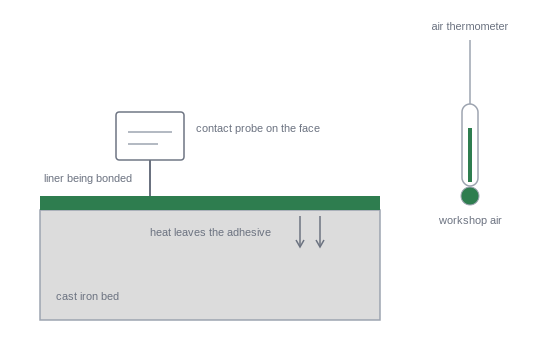
What the cold does to the mix
Three things change at once, and they compound. Viscosity rises, so the same batch spreads thinner and sits on top of the surface profile instead of wetting into it. Metering drifts, because pumping a cold Part B out of a cartridge takes more effort and the volume ratio quietly moves away from what the pack was designed to deliver. And any surface below the dew point collects moisture, which is the failure that hides best: a water film on a machined face is invisible under a smear of adhesive.
Wetting is the one to watch. A cold mix can look perfectly even and still be sitting on the metal rather than keyed to it. The difference only shows when the joint is loaded, and by then the strip is on the machine.
Failure modes that appear weeks later
- One end lifts, usually the end furthest from where mixing started: the adhesive arrived after its working window had already closed.
- The joint holds at the edges and sounds hollow in the middle: air or moisture was trapped and the film never wetted the centre.
- A joint that passes a pull test the next morning and fails in service: the adhesive never reached its full properties because it cured cold.
- A corner creeps under load: partial cure read as a load problem.
- The strip stays bonded but the machine cuts a taper: the liner is attached but not seated, because cold adhesive did not flow under the strip.
The checks that replace guesswork
- Measure the face, not the room. A contact probe at three points along the machined face gives the number that matters. An infrared gun is a first look only, since it reads emissivity and is thrown off by oil film and chips.
- Compare the face reading with the dew point. If the face is at or below it, stop and warm the part; wiping the surface and carrying on does not remove the moisture that returns within minutes.
- Bond a test coupon from the same batch to a scrap of the same metal, leave it beside the machine overnight, and break it the next day. Peeling with a clean interface means the surface or the temperature was wrong. This costs one offcut and answers the question the label cannot.
- Time the batch instead of trusting the printed open time. That figure was written for a warm shop; at a cold face the practical window is shorter, and the clock starts when the two parts meet, not when spreading begins.
- Read the squeeze-out. A wetted joint pushes a continuous bead along the edge. Beads that appear only where pressure was applied mean the film is starved elsewhere, and that is the area that will lift first.
When the shop cannot be warmed
There are three honest options. Warm the part rather than the room, and prove it by re-reading the face. Work in smaller sections so each batch is placed and closed inside its real window. Or postpone the bond. What does not work is heating the shop for an hour and assuming the bed has followed; the bed is the thing that has not followed, and it is the only surface the adhesive touches.
Thickness decides how much of this you can absorb. A 1.0 mm strip has little material to bridge a starved film and a cold joint shows up quickly as a lifted edge, while a 2.0 mm strip tolerates a slightly poorer film before the same symptom appears. Neither thickness fixes a wet or cold face, and on vertical or inverted faces the same temperature problem arrives with gravity added. The substrate side, which metals accept the bond and what each needs first, is set out in liner material compatibility.