Turcite B Sheet 1.0 mm for Guideway Liner
The thin end of the range, for rebuilds where the way was only lightly corrected.
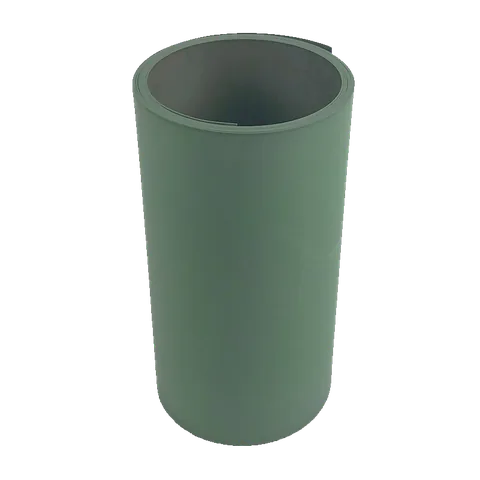
This is the 1.0 mm slice of the standard range: skived PTFE-based slideway strip, one side treated for epoxy, supplied in 100 / 200 / 300 / 305 mm widths and 5 to 20 m rolls with cut-to-length accepted. The material is the same as our other thicknesses. What changes at 1.0 mm is how much wear it can absorb before the counterface is cut again, and how it behaves on the bench while you bond it.
1.0 mm sits at the thin end of the 0.8-3.2 mm range we skive. It is not a separate grade of material; the formulation and the treatment on the bonding face are the same as the thicker strips. The difference is geometric: less material above the bond line, which changes both where the sheet is the right order and how it has to be handled during fitting.
A thin liner earns its place when the way was only lightly corrected. If the saddle or table still carries most of its original surface and the wear has been taken off with a light pass rather than a heavy one, 1.0 mm restores the running surface without pushing the stack height past what the gib or the screw nut can still absorb. It also suits small saddles, cross slides and gib strips where the surrounding structure was never deep enough for a thicker strip. Where a deep wear step has to be machined out, a thicker sheet is the honest answer; forcing 1.0 mm to fill that gap does not restore the geometry, it just moves the discrepancy into the bond line where you can no longer see it.
A purchase order for this thickness is only complete when it carries five things. Thickness written out as 1.0 mm, because "1 mm" gets read as 1.6 mm at the packing stage more often than anyone expects. Width in millimetres. Either the roll length or the individual piece lengths you need. The colour grade, so the invoice matches the material already running on the machine. And the delivery country, so the export paperwork is raised against the right destination. When you order cut pieces, give the lengths and the quantity of each; they come off the roll, so a mixed list is quoted as one order rather than several.
Handling is where a thin strip separates itself from a thick one. Off the roll, 1.0 mm curls more and will try to lift at the edge while the epoxy is still open. Lay it flat first and let it relax before any adhesive is mixed. Bond in one direction with a squeegee or roller instead of pressing from the middle outwards, so trapped air is driven to an edge rather than into a pocket under the middle of the strip. Clamp evenly across the full length: a few heavy clamps in the centre starve both ends of pressure and leave the bond line thickest exactly where the strip is most likely to lift first.
After cure the sheet is machined to final size the same way as any liner, by milling, grinding or scraping, with oil grooves cut afterwards rather than before. The finishing margin is small at this thickness. A pass that goes too deep leaves too little material above the bond for the strip to hold its shape under load, and a pass that stops early leaves a high spot that shows up as a diagonal contact pattern once spotting paste is applied. Take the finishing in light passes and check contact before the final one, not after it.
On receipt, check three things before the roll goes on the shelf: the thickness marked on the strip against the order, that the treated bonding face is identifiable, and that the delivered length matches. Store the roll supported and out of direct sun. A thin strip that has taken a set in storage needs longer to relax on the bench, and relaxing time is not something you can shorten by clamping harder.
Specifications
- Color
- Green
- Thickness
- 1.0 mm
- Thickness Range
- 0.8 / 1.0 / 1.2 / 1.6 / 1.7 / 2.0 / 2.5 / 3.0 / 3.2 mm
- Standard Widths
- 100 mm / 200 mm / 300 mm / 305 mm
- Standard Roll Length
- 5 m / 10 m / 15 m / 20 m (cut-to-length available)
- OEM / Custom Size
- Acceptable
- Bonding Face
- One side chemically treated for two-part epoxy
Technical guides for this material
- Slideway Liner Load and Pressure: Engineering Design Limits for PTFE Tape
- Slideway Liner Creep and Permanent Set Under Sustained Load
Where this material is used
- CNC Machining Centres — Turcite B sheet for CNC machining centre guideways: 0.8–3.2 mm thick, 100–305 mm wide, cut to length. Wholesale supply and factory quotation on request.
- Milling Machines — Turcite B slideway strip for milling machine tables, knees and rams: 0.8–3.2 mm thick, 100–305 mm wide, cut to length. Wholesale and OEM supply.
- Grinder Guideways — Turcite B liner for surface and cylindrical grinder tables and wheelheads. 0.8–3.2 mm, 100–305 mm wide, cut to length. Bulk and custom supply.
How to bond and finish the liner
Questions about this material
- How do I choose the thickness?
- Thickness is set by how much metal has to come off the worn way during reconditioning, plus the clearance the machine design needs. The liner restores centre height, so ordering it before the way has been measured is the most common reason a reline ends up out of alignment.
- Which side of the strip is bonded?
- The treated, darker side bonds to the metal. The lighter face is the running surface and is machined after the adhesive has cured. Bonding the wrong face produces a joint that looks acceptable and fails in service.
- Can the liner be machined after bonding?
- It has to be. Milling, grinding or hand scraping brings the face to final geometry and cuts the oil grooves. Take shallow passes with sharp tooling and support the strip from underneath; an aggressive cut loads the bond line and can push the face off true.
All frequently asked questions
Other materials in this range
- Turcite B Replacement Blue — All-purpose low-friction slideway strip for machine tool guideways.
- Turcite B Replacement Green — Green-grade slideway strip with a balanced friction and wear profile.
- Turcite B Replacement Brown — Brown slideway tape for guideway repair and machine rebuilds.