Turcite B Sheet 2.0 mm for Large Way Surfaces
For large surfaces where the wear step was machined out and the running face will be cut after bonding.
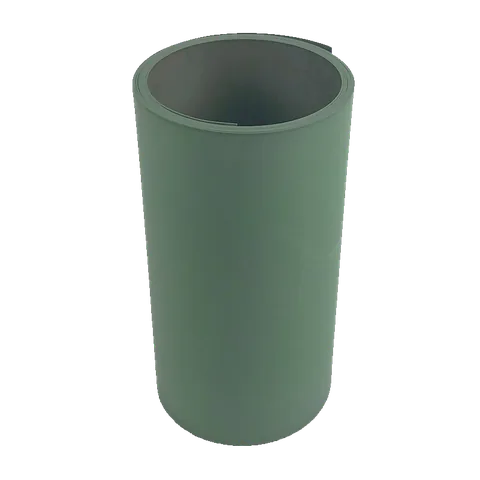
2.0 mm PTFE slideway sheet for large tables and heavy ways, supplied in 100-305 mm widths and 5-20 m rolls or cut to length, with one treated bonding face.
2.0 mm is the top of the practical range for machine-tool ways, and it is ordered for one reason: the wear step had to be machined out rather than polished away, and the structure underneath is large. It is not a stronger grade. Thickness does not add load capacity on its own — it adds height to the stack, which is a geometry decision, not a strength decision.
Large sheets are handled differently from strips, and that is where most of the risk sits. A 2.0 mm panel over a long table is heavy and awkward: it will sag in the middle when you lift it by two corners, and once the epoxy is on it you cannot lift it again to reposition. Dry-fit first, mark both long edges with a scribe line on the parent iron, and stage the sheet on a clean support at the height of the way so it only has to travel sideways into position. Roll it down from one long edge with a roller, working the contact line forward. Do not press from the centre outwards on a panel this size — that traps air in two pockets instead of pushing it to one free edge.
Bond coverage needs planning on a big area. Mix in batches you can spread before the open time closes, and spread the adhesive in one direction across a section, not in circles. If you run out mid-panel and stop to mix more, the first section has already started to skin over and the second will not knit to it. Sections should meet at a wet edge, which means mixing enough for two adjacent sections before you start laying.
The running face is a blank, not a bearing surface. A skived sheet arrives flat in the sense that it is uniform, not flat in the sense the machine needs. The final surface has to be machined or hand-scraped after the adhesive has cured, and the reason is geometric: the liner has to match the way it sits on, and that way was cut, worn or re-machined before you started. You cannot buy that shape. On a large surface the error you are removing is usually a twist or a lengthwise bow, not a local high spot, so the first passes are about establishing the plane and the later ones about contact.
Sequence after cure: machine or scrape to geometry, spot with paste to read the contact pattern, correct the pattern, and cut oil grooves last. Cutting grooves before the face is finished means cutting them to a surface that is about to move. If the machine has a gib or a tapered strip, check its travel after the face is finished, not before — the face you just cut is what sets the running clearance.
Where 2.0 mm is the wrong order: if the wear was shallow and the parent iron is still close to original, a thinner sheet restores the surface without adding height the gib or the screw cannot absorb. Added height has to go somewhere. If nobody has checked the adjustment range before the sheet is ordered, that check belongs before the order, not after the bond has cured.
Specifications
- Color
- Green
- Thickness
- 2.0 mm
- Thickness Range
- 0.8 / 1.0 / 1.2 / 1.6 / 1.7 / 2.0 / 2.5 / 3.0 / 3.2 mm
- Standard Widths
- 100 mm / 200 mm / 300 mm / 305 mm
- Standard Roll Length
- 5 m / 10 m / 15 m / 20 m (cut-to-length available)
- OEM / Custom Size
- Acceptable
- Bonding Face
- One side chemically treated for two-part epoxy
Technical guides for this material
- Slideway Liner Load and Pressure: Engineering Design Limits for PTFE Tape
- Machine Accuracy After Relining: Positioning and Repeatability Checks
Where this material is used
- Machine Tool Rebuilds — Turcite B sheet, epoxy and spotting paste for way relining and machine rebuilds. 0.8–3.2 mm thick, cut to length, wholesale supply with factory quotation.
- Grinder Guideways — Turcite B liner for surface and cylindrical grinder tables and wheelheads. 0.8–3.2 mm, 100–305 mm wide, cut to length. Bulk and custom supply.
- Milling Machines — Turcite B slideway strip for milling machine tables, knees and rams: 0.8–3.2 mm thick, 100–305 mm wide, cut to length. Wholesale and OEM supply.
How to bond and finish the liner
Questions about this material
- How do I choose the thickness?
- Thickness is set by how much metal has to come off the worn way during reconditioning, plus the clearance the machine design needs. The liner restores centre height, so ordering it before the way has been measured is the most common reason a reline ends up out of alignment.
- Which side of the strip is bonded?
- The treated, darker side bonds to the metal. The lighter face is the running surface and is machined after the adhesive has cured. Bonding the wrong face produces a joint that looks acceptable and fails in service.
- Can the liner be machined after bonding?
- It has to be. Milling, grinding or hand scraping brings the face to final geometry and cuts the oil grooves. Take shallow passes with sharp tooling and support the strip from underneath; an aggressive cut loads the bond line and can push the face off true.
All frequently asked questions
Other materials in this range
- Turcite B Replacement Blue — All-purpose low-friction slideway strip for machine tool guideways.
- Turcite B Replacement Green — Green-grade slideway strip with a balanced friction and wear profile.
- Turcite B Replacement Brown — Brown slideway tape for guideway repair and machine rebuilds.